











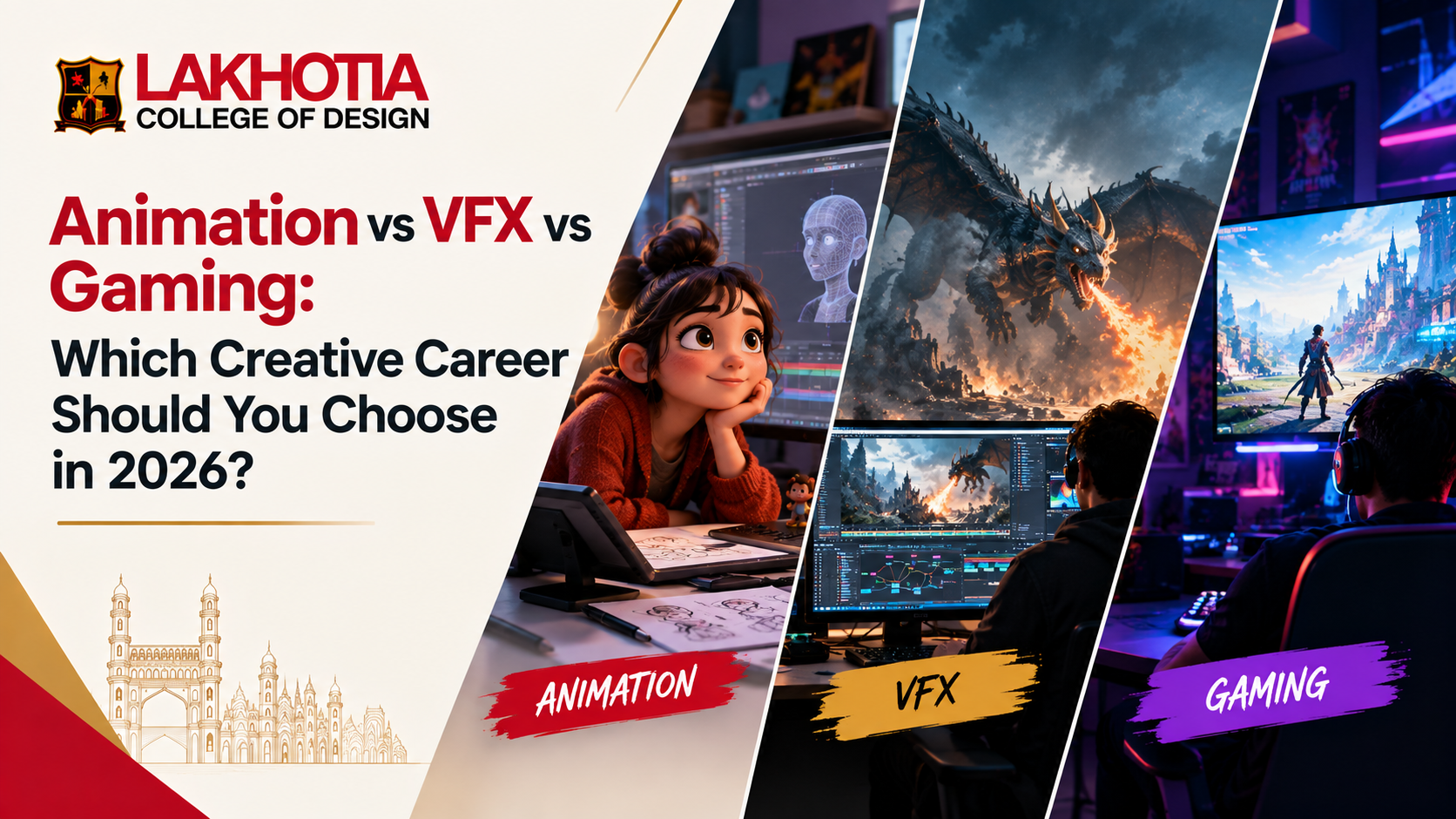
Ask a student interested in "working in movies or games" what they actually want to do, and most cant immediately tell you whether that means Animation, VFX, or Gaming. Its an understandable confusion — all three fields overlap in software, in the kind of creative-technical thinking they demand, and often in the same production pipelines. A single film can employ animators, VFX artists, and game-adjacent 3D specialists on the same project.
But underneath the overlap, these are three genuinely different careers, with different day-to-day work, different industries hiring for them, and different skills that separate someone who thrives from someone who struggles. Choosing based on vague interest in "creative tech work" without understanding these differences is how students end up training for one field and discovering their actual interest lies in another — an expensive and time-consuming mistake to make after enrolling.
This guide is built specifically to prevent that mistake. It compares Animation, VFX, and Gaming directly across course structure, curriculum, eligibility, required skills, career paths, and realistic salary expectations in India for 2026 — so you can make this decision based on a clear understanding of what each field actually involves, not just a gut feeling about which sounds more exciting.
Table of Contents
What Are Animation, VFX and Gaming?
Why Choose a Creative Career in 2026?
Animation vs VFX vs Gaming: Key Differences
Animation Courses: Duration & Curriculum
VFX Courses: Duration & Curriculum
Gaming Courses: Duration & Curriculum
Animation vs VFX vs Gaming: Eligibility & Admission Process
Animation vs VFX vs Gaming: Skills Required
Animation vs VFX vs Gaming: Career Opportunities
Animation vs VFX vs Gaming: Salary & Career Scope in India
How to Choose the Right Creative Career in 2026?
Best Career Option After 12th: Animation, VFX or Gaming?
FAQs About Animation, VFX and Gaming Careers
What Are Animation, VFX and Gaming?
Animation
Animation is the craft of bringing characters, objects, and stories to life through sequential movement — spanning 2D animation (traditional and digital), 3D character and object animation, and stylised motion graphics. Animators work across films, television, streaming series, advertising, and explainer content, focusing primarily on performance, timing, and storytelling through movement.
VFX (Visual Effects)
VFX is the creation and manipulation of imagery that doesnt exist in raw filmed footage — photorealistic creatures, environments, explosions, and the seamless digital extension of physical sets. VFX artists typically specialise in one stage of a technical pipeline: modelling, texturing, compositing, lighting, rendering, or rotoscopy, primarily serving film, television, and streaming production.
Gaming (Game Design & Development)
Gaming careers span the design and development of interactive digital games — game design (rules, mechanics, level and systems design), game art (2D/3D visual assets, characters, environments), and game development (programming and technical implementation using engines like Unity or Unreal). Unlike animation and VFX, which produce fixed, linear visual content, gaming careers centre on building interactive systems the player actively controls.
Why Choose a Creative Career in 2026?
All three fields benefit from the same broad structural trend: Indias position as a major global hub for content and technology production. The streaming and OTT boom has multiplied demand for both animated content and VFX work. Indias gaming industry has grown rapidly, driven by mobile gaming adoption and a maturing domestic game development ecosystem. Across all three fields, Indian studios increasingly work on international projects alongside a growing domestic industry, creating sustained demand for trained creative-technical professionals rather than a short-term trend.
Animation vs VFX vs Gaming: Key Differences
Animation Courses: Duration & Curriculum
Common curriculum areas in Animation courses:
2D animation principles and techniques
3D character and object animation
Storyboarding and visual storytelling
Character design and development
Rigging fundamentals (how models are built to move)
Motion graphics and title/broadcast design
Animation production pipeline and studio workflow
VFX Courses: Duration & Curriculum
Common curriculum areas in VFX courses:
3D modelling and texturing
Compositing — combining visual layers into a final image
Lighting and rendering for photorealism
Rotoscopy — frame-by-frame element isolation
Visual effects production pipeline and workflow
Motion graphics, where offered as part of the VFX track
Gaming Courses: Duration & Curriculum
Common curriculum areas in Gaming courses:
Game design fundamentals — mechanics, rules, and player experience
Level design and environment design
Game art — 2D and 3D asset creation for interactive environments
Game engines — Unity and/or Unreal Engine training
Basic game programming and scripting
UI/UX design specific to interactive game interfaces
Game production pipeline and studio workflow
Students can choose from certificate, diploma, undergraduate, and specialised programmes across all three fields depending on their educational background, available timeline, and career goals — a certificate suits fast, focused entry into one specific skill, while a full degree provides broader foundational depth.
Animation vs VFX vs Gaming: Eligibility & Admission Process
Animation vs VFX vs Gaming: Skills Required
Animation vs VFX vs Gaming: Career Opportunities
Animation vs VFX vs Gaming: Salary & Career Scope in India
These figures reflect general industry ranges in India and vary by studio, city, specialisation, and portfolio strength. Gaming salaries, particularly for senior programming and technical design roles, tend to sit at the higher end given overlap with the broader software engineering job market — while VFX leadership and specialised freelance/international project work can also reach comparable levels depending on reputation and client base.
How to Choose the Right Creative Career in 2026?
Rather than choosing based on which field sounds most exciting, ask yourself these grounded questions.
Do you enjoy character performance and storytelling through movement more than technical realism? — Animation may fit better.
Do you enjoy solving technical, precision-focused visual problems and making things look photorealistic? — VFX may fit better.
Do you enjoy designing systems, rules, and interactive experiences — thinking about what a player does, not just what they see? — Gaming may fit better.
Are you drawn to programming and technical systems as much as visual creativity? — Gamings development track specifically may fit better than Animation or VFX.
Do you want the widest range of industries hiring for your skill (film, TV, streaming, advertising)? — Animation and VFX both offer this breadth; Gaming is more concentrated in the games and interactive media industry specifically.
Its also worth acknowledging that these fields share enough foundational overlap — particularly in 3D software and visual fundamentals — that switching direction after starting is possible, though it does cost time. Choosing thoughtfully at the outset, rather than by default, saves that cost.
Best Career Option After 12th: Animation, VFX or Gaming?
There is no single best answer to this question that applies to every student — and any guide claiming otherwise is oversimplifying a genuinely personal decision. What can be said clearly is this: each field rewards a different kind of thinker. Animation rewards those who think like performers and storytellers. VFX rewards those who think like technical craftspeople chasing realism. Gaming rewards those who think like systems designers or, for development-focused tracks, like programmers with creative instincts.
The most reliable way to decide is not to pick the field with the highest advertised salary or the most exciting demo reel, but to spend time — through tutorials, breakdown videos, or a short introductory workshop if available — actually trying the core activity of each field before committing years of training to one. Genuine engagement with the day-to-day work matters more than the industrys overall growth numbers, since all three fields are growing, and success in any of them depends far more on individual skill and specialisation depth than on which one you picked.
Why Choose Lakhotia College of Design
For students weighing Animation, VFX, and Gaming as career options, Lakhotia College of Designs approach across its creative-technology programmes is built on a shared principle: genuine craft depth — art fundamentals, technical precision, and creative problem-solving — matters more than software familiarity alone, regardless of which of these three fields a student ultimately chooses.
Lakhotias 75:25 practical learning model applies across its Animation and VFX programmes, ensuring students build real production experience rather than relying on tutorial-style instruction alone. Faculty bring genuine industry background, and students build a portfolio or showreel throughout their training — the single most important asset for entering any of these three fields, regardless of specialisation.
Eligibility, fees, and the specific admission process are confirmed directly during counselling — prospective students are encouraged to contact the admissions team to discuss which specific programme and specialisation best fits their interests.
FAQs About Animation, VFX and Gaming Careers
1. Which pays more — Animation, VFX, or Gaming?
At senior and leadership levels, gaming careers — particularly programming and senior technical design roles — tend to reach the highest compensation ranges in India, partly due to overlap with the broader software engineering job market. However, at entry and mid-level, Animation, VFX, and Gaming offer broadly comparable salary ranges, and specialisation depth and portfolio quality matter more to individual earning potential than which field you choose overall.
2. Can I switch from Animation to VFX (or vice versa) later in my career?
Yes, this is fairly common given the overlapping software and technical fundamentals — particularly 3D modelling and rendering skills — shared between the two fields. The transition typically requires building specific new skills (such as compositing for a move into VFX, or performance and timing for a move into animation) but is a realistic mid-career pivot for many professionals. Switching into or out of Gaming is somewhat less common due to its distinct focus on interactivity and, for development roles, programming.
3. Is Gaming a good career choice if Im not interested in programming?
Yes. Gaming careers include strong non-programming tracks such as game design, level design, and game art (2D/3D visual asset creation), which draw more on creative and design thinking than on coding. Programming-focused game development is only one path within the broader gaming industry, not a requirement for every role.
4. Which of these three fields has the most job opportunities in India?
Animation and VFX currently offer the broadest range of hiring industries in India — film, television, streaming, and advertising all draw on both skill sets — while Gamings job market, though growing rapidly, remains somewhat more concentrated within dedicated gaming studios and mobile game publishers specifically. That said, gaming is the faster-growing of the three in relative terms, driven by mobile gaming adoption and a maturing domestic development ecosystem.
5. Do Animation, VFX, and Gaming courses require the same eligibility after 12th?
Broadly, yes — most institutions accept Class 12 pass from any stream for certificate, diploma, and degree-level entry across all three fields. Programming-heavy Gaming development tracks specifically sometimes prefer or require a Science or Mathematics background, though this varies by institution. Confirm exact eligibility directly with each college or institute youre considering.
6. Should I choose based on salary potential or genuine interest?
Genuine interest should weigh more heavily than salary potential when choosing between these three fields, because all three reward sustained skill development over years — professionals who are only motivated by salary tend to plateau faster than those genuinely engaged with the craft. That said, its reasonable to weigh realistic salary and industry demand as one factor among several, alongside genuine interest and the specific type of creative-technical thinking that comes naturally to you.
Explore Animation, VFX, and creative technology admissions for 2026 at Lakhotia College of Design, Hyderabad. Contact the admissions team at +91-98853 91914 or visit lakhotiaedu.com to schedule a campus visit.





.png)






Leave a reply