










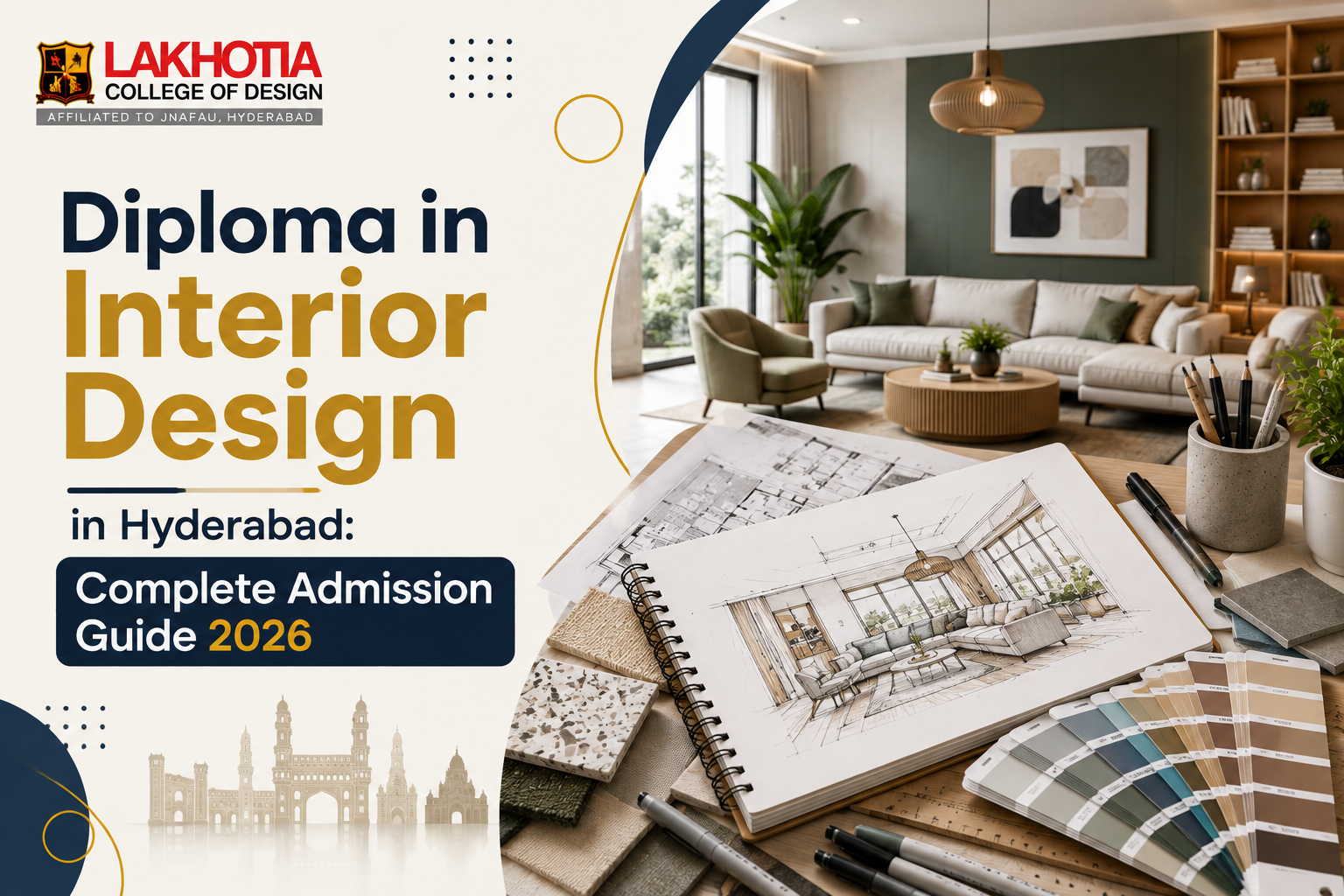
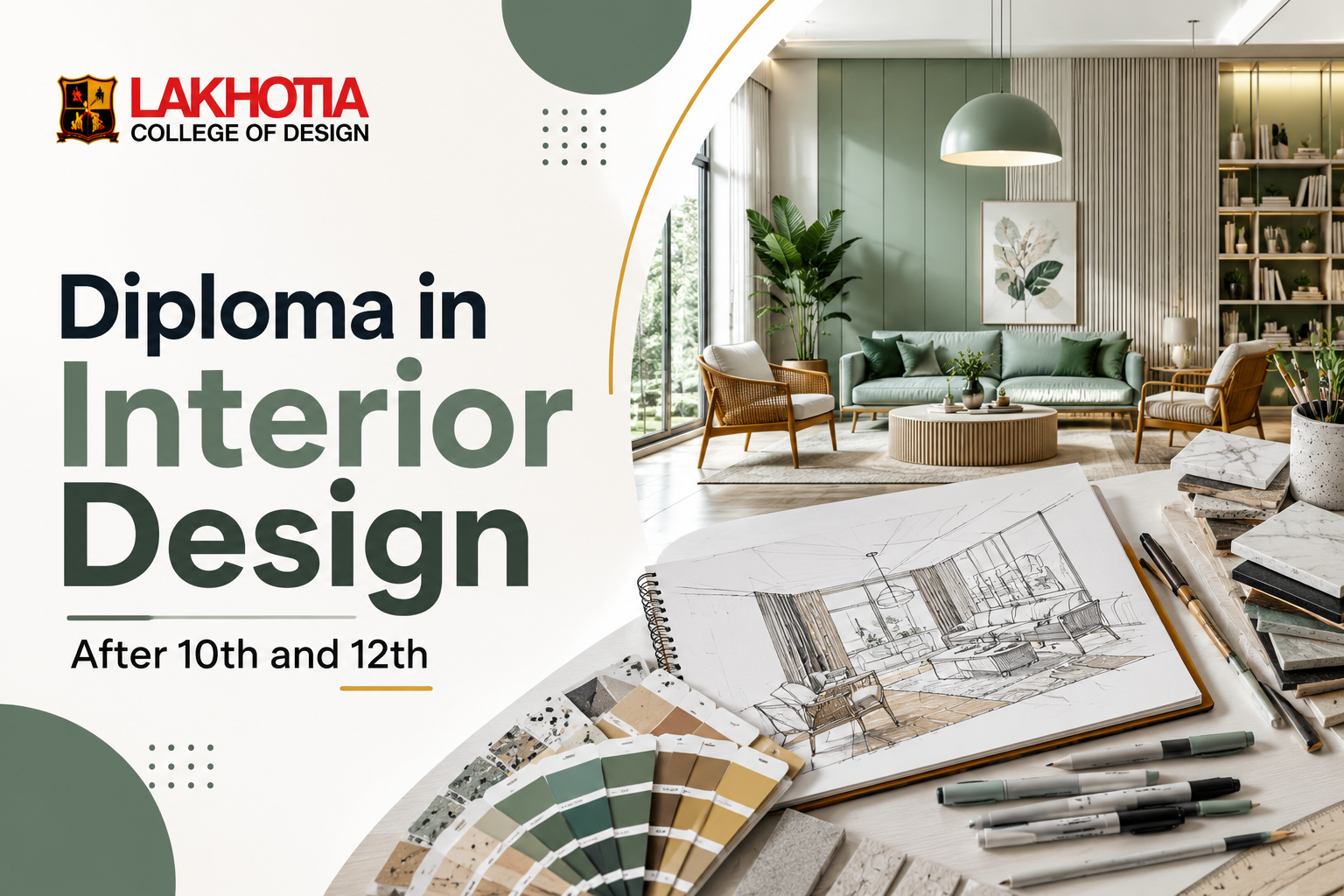
Not every student who wants to build a career in interior design needs or wants a three-year undergraduate degree. For many, a one-year diploma is the more appropriate starting point — faster entry into the profession, lower total cost, and a focused curriculum that covers the practical essentials without the extended academic commitment of a degree programme.
Hyderabad has a well-established cluster of design institutions offering Diploma in Interior Design programmes at varying levels of quality and depth. Navigating those options requires a clear understanding of what a diploma actually involves, who it is suited for, and how to evaluate the institutions offering it.
This guide covers the complete admission process for Diploma in Interior Design programmes in Hyderabad for 2026 — eligibility criteria, application process, curriculum overview, career pathways, and the criteria that separate genuinely strong programmes from those that are merely convenient.
Table of Contents
- What is a Diploma in Interior Design?
- Who Should Choose a Diploma Over a Degree?
- Eligibility for Diploma in Interior Design in Hyderabad
- Admission Process 2026: Step by Step
- Curriculum: What a Diploma in Interior Design Covers
- Career Opportunities After a Diploma in Interior Design
- Fees and Duration: Diploma in Interior Design in Hyderabad
- How to Choose the Right Interior Design Diploma Programme
- FAQs About Diploma in Interior Design in Hyderabad
What is a Diploma in Interior Design?
A Diploma in Interior Design is a focused, professional qualification that typically spans one to two years and covers the core practical and technical skills required for entry-level practice as an interior designer. Unlike a degree programme, a diploma does not carry full undergraduate academic credit, but it provides the applied skills — space planning, drafting, material selection, 3D visualisation, and project management basics — that employers require for junior designer and design assistant roles.
In the context of Hyderabads interior design market, a diploma graduate who has developed strong practical skills, a genuine portfolio, and professional relationships during the course is competitive for entry-level employment across residential, commercial, and retail interior design sectors.
Who Should Choose a Diploma Over a Degree?
The diploma versus degree question is genuinely important and deserves a direct answer rather than a generic preference for the longer qualification.
Choose a Diploma if... | Choose a Degree if... |
You want to enter the workforce within 1-2 years | You want the deepest possible qualification foundation |
You are funding your own education and budget is a priority | You plan to apply for postgraduate programmes later |
You have already completed a degree in another field | You want maximum flexibility in your career options |
You want to complement existing skills in architecture or construction | You want the full breadth of design theory and specialisations |
You are a working professional upskilling | You are a student directly from Class 12 with no prior design exposure |
Eligibility for Diploma in Interior Design in Hyderabad
Criterion | Requirement |
Minimum Qualification | Class 10 or Class 12 (varies by programme level) |
Minimum Marks | 40-45% aggregate (institution-specific) |
Age | No upper age limit in most programmes |
Stream | No mandatory stream — all streams eligible |
Assessment | Design aptitude test or portfolio review |
Documents | Mark sheets, photographs, identity proof |
The eligibility threshold for diploma programmes is generally lower than for degree programmes, making diplomas accessible to a wider range of students — including those who have completed Class 10 but not yet Class 12, and working professionals returning to education at any age.
Admission Process 2026: Step by Step
Research and Shortlist Programmes
Begin with a clear assessment of what you need from the programme. How long can you commit? What is your budget? Do you need the qualification to be affiliated with a university? Are you interested in a general interior design diploma or a specialised one (residential, commercial, or retail focus)? Answers to these questions should drive your shortlisting.
Submit Application
Applications for 2026 are generally accepted from March through June, with some institutions offering rolling admissions throughout the year for diploma programmes. Submit application forms with full academic documentation. Some programmes accept applications online; others require in-person submission.
Aptitude Assessment
Most diploma programmes conduct a design aptitude test to assess spatial thinking, visual sensitivity, and creative problem-solving. This is not a test of prior knowledge but of innate and developed aptitude. Preparation involves practising observational drawing, studying the proportions and spatial organisation of interiors you find well-designed, and being prepared to discuss your design preferences and inspirations.
Interview
Many institutions conduct a brief personal interview as part of the diploma admission process. This evaluates communication skills, professional motivation, and creative interests. Having a small collection of your own creative work — sketches, photographs of spaces you admire, or mood boards — to share during the interview strengthens your application.
Enrolment and Fee Payment
Successful applicants receive an admission offer and must complete enrolment — including fee payment and document submission — within the specified deadline. Diploma programmes often fill faster than degree programmes because of their shorter duration and lower total cost. Act promptly on any offer received.
Curriculum: What a Diploma in Interior Design Covers
A one-year Diploma in Interior Design at a quality institution typically covers the following areas. The balance between subjects varies across institutions, but the core competencies are broadly consistent.
Module | Topics Covered |
Design Fundamentals | Elements and principles of design, spatial awareness, proportion, scale |
Drawing and Drafting | Freehand sketching, technical drawing, floor plans, elevations |
Colour and Materials | Colour theory, material properties, fabric, flooring, wall finishes |
Space Planning | Ergonomics, furniture arrangement, traffic flow, functional zoning |
AutoCAD | Technical drawing software for interior plans and presentations |
3D Visualisation | SketchUp modelling, basic rendering for client presentations |
Lighting Design | Natural and artificial lighting, fixture selection, lighting plans |
Project Studio | Applied residential and commercial interior projects with real briefs |
Career Opportunities After a Diploma in Interior Design
Junior Interior Designer
The most direct employment outcome for diploma graduates is a junior designer role at an established interior design studio or architecture firm. In this capacity, designers assist senior professionals with drafting, material sourcing, client presentation preparation, and site coordination. This is where the practical skills developed during the diploma are applied directly, and where the most rapid professional learning typically occurs.
Design Assistant at Residential Projects
Many interior design studios in Hyderabad run residential project teams where diploma graduates function as project-specific design assistants — coordinating between the senior designer, contractors, and clients for individual home or apartment projects. This role offers early responsibility and direct client contact.
Furniture and Retail Showroom Coordinator
Furniture manufacturers, home decor retailers, and material suppliers employ interior design diploma graduates as showroom consultants and space planning advisors — helping clients select products that work together in their specific spaces. This role suits graduates with strong material knowledge and client communication skills.
Freelance Interior Design Consultant
Diploma graduates with strong portfolios and practical skills can establish freelance practices, particularly in residential interior design for individual homeowners. The freelance path requires strong self-marketing and project management discipline, but offers flexibility and potentially higher per-project earnings than salaried employment.
Pathway to Advanced Qualification
A diploma is not a career ceiling. Many diploma graduates use their first two to three years of professional experience to build the portfolio and savings necessary to pursue a BA or advanced diploma — effectively combining practical experience with academic advancement.
Role | Starting Salary | Typical Sector |
Junior Interior Designer | Rs 2 - 3 Lakhs/year | Design studios, architecture firms |
Design Assistant | Rs 1.8 - 2.8 Lakhs/year | Residential project teams |
Showroom Consultant | Rs 2 - 3 Lakhs/year | Furniture and decor retail |
Freelance Consultant | Rs 2.5 - 5 Lakhs/year (variable) | Residential clients |
Fees and Duration: Diploma in Interior Design in Hyderabad
Programme Level | Duration | Annual Fee Range | Total Cost |
Diploma (basic) | 1 year | Rs 70,000 - 1.2 Lakhs | Rs 70,000 - 1.2 Lakhs |
Advanced Diploma | 2 years | Rs 80,000 - 1.5 Lakhs/year | Rs 1.6 - 3 Lakhs total |
Diploma + Industry Internship | 1 year + 3-6 months | Rs 80,000 - 1.4 Lakhs | Rs 80,000 - 1.4 Lakhs |
How to Choose the Right Interior Design Diploma Programme
Assess Practical Hours vs Classroom Hours
The single most important structural factor in a diploma programme is the ratio of applied studio work to classroom instruction. In interior design, skills are built through doing — through drawing floor plans, selecting materials, building 3D models, and completing real project briefs. A programme that is predominantly classroom-based is not delivering the practical depth required for employment. Ask specifically about the studio-to-classroom ratio.
Check Industry Connections
A diploma programme with strong industry connections — active internship partnerships, visiting practitioners, studio visits, and industry workshop series — is providing value that purely internal instruction cannot. These connections also generate employment leads after graduation.
Evaluate the Portfolio Development Process
Your portfolio is the primary tool with which you will seek employment after completing the diploma. A programme that builds portfolio development into its curriculum — that assigns real project briefs and builds toward an exhibition or formal presentation — is directly serving your employability. Ask to see portfolios of recent graduates.
Confirm Institutional Recognition
Check whether the diploma is issued by an institution with recognised educational status and, where possible, university affiliation. Unaffiliated diplomas can limit higher education options if you wish to pursue a BA or advanced qualification later.
Why Choose Lakhotia College of Design
Lakhotia College of Designs Diploma in Interior Design programme carries the weight of over 30 years of design education behind it. The institutions approach to diploma-level study reflects the same 75:25 practical emphasis that defines all its programmes — students spend the majority of their time in studio environments, working on projects that develop real skills and build portfolios that employers find convincing.
The diploma curriculum at Lakhotia is regularly updated to reflect current industry practice — tools, materials, and design standards that are actually used in Hyderabads interior design market, not outdated frameworks carried forward from previous decades. Students benefit from industry workshops, mentorship from practising designers, and access to the colleges extensive material library and studio infrastructure.
For students who complete the diploma and wish to continue into the BA programme, Lakhotia offers pathways that recognise diploma-level learning. The college placement assistance extends to diploma graduates, who are connected to the wider network of employers and alumni that a 30-year institution has developed.
Conclusion
A Diploma in Interior Design in Hyderabad is a practical, professionally viable qualification for students who want to enter the interior design profession without committing to a three-year degree. The key is selecting a programme with genuine practical depth, strong industry connections, and a clear pathway to employment — criteria that distinguish the programmes worth pursuing from those that are merely convenient.
Explore Diploma in Interior Design admissions for 2026 at Lakhotia College of Design, Hyderabad. Call +91-98853 91914 or visit lakhotiaedu.com to schedule a campus visit.




.png)

Leave a reply