










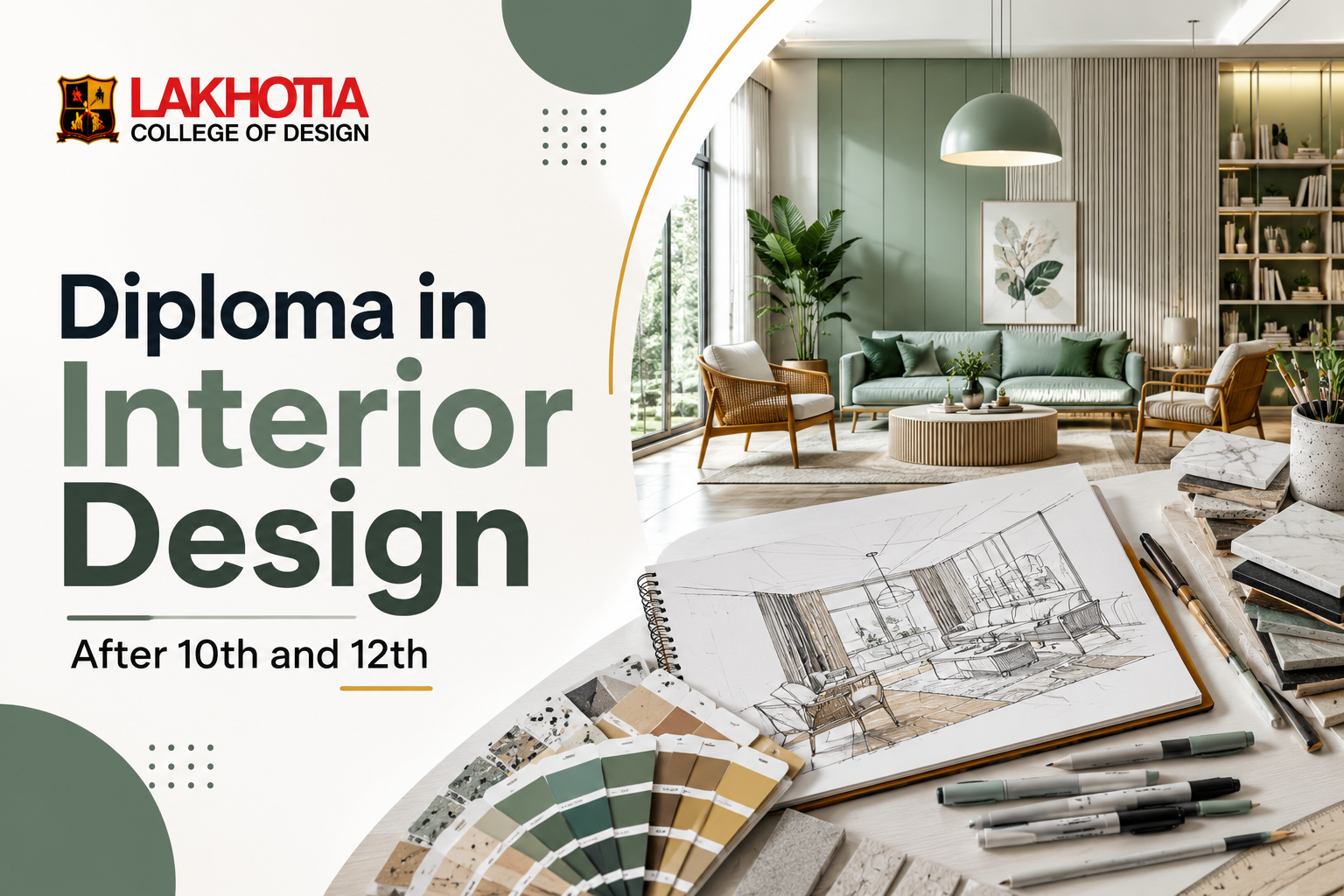
One of the most frequently asked questions by students finishing their Class 10 or Class 12 examinations is whether a diploma in interior design is a realistic option at this stage of their education — and if so, which path is more appropriate: starting the diploma after Class 10 or waiting until after Class 12.
The honest answer is that both pathways are viable, but they suit different students for different reasons. A student who finishes Class 10 and has a strong creative inclination, a genuine interest in spaces and environments, and a desire to enter professional training sooner rather than later is a reasonable candidate for a post-10th diploma. A student who completes Class 12 has the additional option of either a diploma or a degree, and that additional choice has implications for long-term career flexibility.
This guide breaks down both pathways in full — eligibility, fees, curriculum, career outcomes, and the practical considerations that should inform the choice. It is written for students themselves, and for the parents and counsellors who support them in navigating these decisions.
Table of Contents
1. Can You Do a Diploma in Interior Design After 10th?
2. Diploma in Interior Design After 12th: What Changes?
3. Eligibility Criteria: 10th vs 12th Entry
4. Curriculum Overview: What You Will Learn
5. Career Scope After Diploma in Interior Design
6. Fees and Duration: Diploma After 10th vs After 12th
7. Skills You Develop in an Interior Design Diploma
8. Diploma vs Degree: Which is Right for You?
9. FAQs About Diploma in Interior Design After 10th and 12th
Can You Do a Diploma in Interior Design After 10th?
Yes. Many recognised interior design institutions accept students into diploma programmes after Class 10, with a pass result and a minimum aggregate that varies between 40 and 50 percent depending on the institution. The post-10th entry is typically into a foundation or basic diploma programme, which may span one to two years and focuses on design fundamentals, drawing, material basics, and introductory space planning.
The case for starting after Class 10 is primarily about timing. Students who are certain about their interest in interior design — who have been drawing, decorating, or observing spaces with genuine enthusiasm for some time — have little reason to spend two more years in general academic education if a professional design programme is available and accessible to them.
The case against starting after Class 10 is equally clear: students who are unsure about their interest, or who have not yet developed sufficient creative maturity, may find that the additional two years of Class 11 and 12 provide useful time for both personal development and academic grounding. Some postgraduate programmes also prefer applicants with Class 12 and a degree rather than a post-10th diploma.
Diploma in Interior Design After 12th: What Changes?
Students who complete Class 12 before pursuing a Diploma in Interior Design have access to a wider range of programme options — including both diploma and degree-level qualifications. The decision between a diploma and a degree at this stage becomes genuinely consequential and deserves careful thought.
A diploma after Class 12 is appropriate for students who want to enter the workforce within one to two years, who have a clear professional goal in interior design, and for whom the longer and more expensive degree programme is not the right fit at this stage. It is also appropriate for students who have been out of formal education for some time and want to re-enter the system through a focused, practical qualification.
A degree after Class 12, by contrast, is appropriate for students who want the deepest possible foundation — covering design theory, advanced specialisations, and the academic depth that postgraduate programmes look for. If higher education or international study is on the horizon, a degree is the stronger qualification.
Eligibility Criteria: 10th vs 12th Entry
|
Criterion |
After Class 10 |
After Class 12 |
|
Minimum Qualification |
Class 10 pass |
Class 12 pass (any stream) |
|
Minimum Marks |
40-50% aggregate |
45-50% aggregate |
|
Programme Options |
Basic Diploma, Foundation Diploma |
Diploma, Advanced Diploma, BA, BSc |
|
Duration |
1-2 years |
1-3 years depending on programme |
|
Assessment |
Drawing test / aptitude test |
Design aptitude test / portfolio review |
|
Further Education |
Can pursue BA after diploma |
Can pursue BA or Masters after diploma |
Curriculum Overview: What You Will Learn
Whether you enter a diploma programme after Class 10 or Class 12, the core curriculum focuses on building the practical skills that interior design practice requires. The depth and pace of instruction varies depending on the entry level and programme duration.
Foundation Level Subjects (Post-10th Entry)
• Basic design elements — line, shape, form, texture, proportion
• Observational drawing and freehand sketching
• Introduction to colour — theory, psychology, and application
• Materials introduction — flooring, wall finishes, textiles, furniture
• Basic space planning concepts
• History of interior design and architecture
Advanced Diploma Subjects (Post-12th Entry)
• Space planning and ergonomics for residential and commercial projects
• AutoCAD — technical drawing, floor plans, elevations, sections
• SketchUp 3D modelling and visualisation
• Lighting design — natural and artificial, fixture specification
• Material specification — full procurement and sourcing process
• Furniture design and custom specification
• Client brief management and project execution
• Rendering and presentation — Photoshop, mood boards, client decks
• Studio projects with real or simulated client briefs
Career Scope After Diploma in Interior Design
The career scope after a Diploma in Interior Design is directly tied to the quality of the programme, the depth of the portfolio developed during study, and the professional relationships built through internships and industry exposure. Here is an honest assessment of what the career trajectory typically looks like.
Year 1-2 After Diploma: Entry Level
Most diploma graduates begin their careers as junior designers, design assistants, or showroom consultants. These roles provide direct exposure to professional practice — site visits, contractor coordination, material sourcing, and client interaction. The learning in these first two years is intensive and forms the foundation of the professional career.
Year 3-5: Growing Responsibility
Designers with two to three years of experience begin to manage their own projects within established firms or to build early-stage independent practices. This is the period when specialisation typically emerges — residential, commercial, hospitality, or retail — driven by the type of work available in the local market and the designers own preferences.
Year 5 and Beyond: Independent Practice or Senior Roles
Experienced interior designers with strong portfolios and established client relationships have the option of building independent studios or moving into senior roles at established firms — project director, studio head, or creative director. This stage is less constrained by the diploma-versus-degree distinction and more determined by the quality and diversity of the professional experience accumulated.
|
Career Stage |
Timeline |
Typical Role |
Salary Range |
|
Entry |
0-2 years post diploma |
Junior designer, design assistant |
Rs 1.8 - 3.5 L/year |
|
Mid level |
3-5 years |
Project designer, studio designer |
Rs 4 - 8 L/year |
|
Senior |
6-10 years |
Senior designer, design director |
Rs 9 - 18 L/year |
|
Independent |
5+ years |
Own studio, consultant |
Rs 12 - 40 L/year (variable) |
Fees and Duration: Diploma After 10th vs After 12th
|
Programme |
Entry Point |
Duration |
Fee Range (Total) |
|
Foundation Diploma |
After Class 10 |
1-2 years |
Rs 70,000 - 1.5 Lakhs |
|
Diploma in Interior Design |
After Class 12 |
1 year |
Rs 70,000 - 1.2 Lakhs |
|
Advanced Diploma |
After Class 12 |
2 years |
Rs 1.5 - 3 Lakhs total |
|
BA Interior Design |
After Class 12 |
3 years |
Rs 2.5 - 7.5 Lakhs total |
The fee comparison above illustrates why diplomas are often the preferred starting point for students who are self-funding their education. The total cost of a diploma is substantially lower than a degree, and for students who have a clear professional goal and strong practical aptitude, the diploma provides a faster and more cost-effective path to employment.
Skills You Develop in an Interior Design Diploma
The skills developed during a well-structured Interior Design Diploma are both technical and professional. Understanding what these skills are — and how they translate to employment — helps prospective students assess whether a programme is delivering what it should.
Technical Skills
• Spatial thinking and three-dimensional visualisation
• Technical drafting by hand and with AutoCAD
• 3D modelling using SketchUp or equivalent software
• Colour specification and material selection
• Lighting planning and fixture specification
• Basic project budgeting and material costing
Professional and Soft Skills
• Client communication — listening to briefs, presenting concepts, managing expectations
• Visual presentation — mood boards, rendered presentations, client decks
• Project management basics — timelines, contractor coordination, site visits
• Creative problem-solving within constraints of budget and space
• Portfolio development and professional self-presentation
Diploma vs Degree: Which is Right for You?
|
Consider a Diploma if... |
Consider a Degree if... |
|
You want employment within 1-2 years |
You want the broadest possible qualification |
|
You are clear about your career direction |
You are still exploring and want maximum depth |
|
Budget is a significant consideration |
You plan to pursue postgraduate education later |
|
You have prior creative exposure or experience |
You are new to design with no prior creative practice |
|
You are a working professional upskilling |
You are entering design directly from school |
This is not a question with a single correct answer. The right choice depends on the individual students circumstances, clarity of purpose, financial situation, and long-term ambitions. What matters most is that the choice is made deliberately rather than by default.
FAQs About Diploma in Interior Design After 10th and 12th
1. Can I do a Diploma in Interior Design after passing Class 10?
Yes. Most design institutes that offer diploma programmes accept students who have completed Class 10 with a minimum aggregate of 40 to 50 percent. The diploma available after Class 10 is typically a foundation or basic-level programme covering design fundamentals, drawing, colour theory, and introductory space planning. This programme is appropriate for students who are certain about their interest in interior design and want to begin professional training as early as possible. Students who complete the post-10th diploma can later progress to advanced diplomas or degree programmes.
2. What is the difference between doing a diploma after 10th versus after 12th?
The primary difference is programme level and subsequent education options. A diploma after Class 10 is a foundation-level qualification covering design basics. A diploma after Class 12 can be either a general diploma or an advanced diploma, with deeper curriculum coverage and stronger employment outcomes. Students entering after Class 12 also have the additional option of pursuing a BA or BSc degree rather than a diploma, giving them a choice that Class 10 completers do not yet have. Employers generally do not distinguish between post-10th and post-12th diplomas provided the portfolio and skills are equivalent, but postgraduate programmes tend to prefer Class 12 plus a degree over a post-10th diploma.
3. How long does a Diploma in Interior Design take to complete?
A standard Diploma in Interior Design takes one year to complete. Advanced diploma programmes span two years and provide deeper coverage of commercial, hospitality, and retail interior design specialisations. Some institutions offer one-year programmes that include a compulsory three to six month internship component, effectively extending the total programme to 18 months. The duration best suited to any individual student depends on their career goals, available time, and budget — a one-year diploma is sufficient for entry-level employment, while a two-year advanced diploma provides stronger preparation for more complex professional roles.
4. What are the career options after a Diploma in Interior Design?
Career options after a Diploma in Interior Design include junior interior designer at design studios or architecture firms, design assistant on residential or commercial projects, showroom consultant at furniture and decor retailers, visual merchandiser at retail brands, and freelance interior design consultant. With two to three years of experience, diploma graduates typically progress to project designer roles with increasing responsibility and compensation. Independent practice — running a personal interior design studio — is a viable pathway for designers who build strong client relationships and portfolio depth during their first five to eight years of professional experience.
5. What is the fee for a Diploma in Interior Design in Hyderabad?
Fees for a Diploma in Interior Design in Hyderabad vary between Rs 70,000 and Rs 1.5 lakhs for a one-year programme, depending on the institution, facilities, and curriculum depth. Advanced diploma programmes spanning two years range from Rs 1.5 to Rs 3 lakhs in total. Some institutions offer merit scholarships and structured payment plans that reduce the financial burden. When evaluating fees, compare them against the placement outcomes of recent graduates — a programme with stronger industry connections and placement support often delivers better return on investment even at a higher fee point.
6. Can I pursue a BA in Interior Design after completing a Diploma?
Yes. Most BA Interior Design programmes recognise diploma-level learning and may grant credit for prior study, potentially reducing the duration of the subsequent degree. Students who complete a diploma and then gain two to three years of professional experience before pursuing a BA are often among the strongest performers in degree programmes because they bring real-world project experience to complement the academic curriculum. Some institutions have structured progression pathways from their own diploma to their own degree programme, making the transition administratively straightforward. Check with individual institutions for their specific credit recognition policies.
Why Choose Lakhotia College of Design
Lakhotia College of Designs Diploma in Interior Design programme is designed to be genuinely useful in the professional market — not simply a credential. The curriculum is current, the studio facilities are applied, and the faculty bring practising experience rather than purely academic credentials. Students who complete the diploma here graduate with a portfolio developed through real project briefs and industry workshops, which is the asset that matters most in securing employment.
For students who enter after Class 10, Lakhotia provides a clear progression pathway through diploma to advanced diploma to BA — so the decision to begin early does not foreclose more advanced study later. The institutions 30-year presence in Hyderabad means that its diploma carries industry recognition among the local design community that newer institutions cannot match.
The colleges 100% placement assistance programme covers diploma graduates alongside degree graduates, connecting students to the employer network built over three decades of design education. For students from outside Hyderabad, the colleges presence across multiple campuses in the city provides accessibility options not available at single-campus institutions.
Conclusion
A Diploma in Interior Design after Class 10 or Class 12 is a legitimate, professionally viable path for students who want to enter the design profession with practical skills, a genuine portfolio, and a qualification recognised by employers. The decision about which pathway is right — post-10th or post-12th, diploma or degree — depends on the individual students clarity of purpose, financial situation, and long-term aspirations.
What matters most in any interior design diploma is not the entry point but the quality of the education received — the practical depth of the curriculum, the experience of the faculty, and the strength of the professional connections the programme provides.
Explore Diploma in Interior Design admissions for 2026 at Lakhotia College of Design, Hyderabad. Call +91-98853 91914 or visit lakhotiaedu.com.




.png)


Leave a reply