










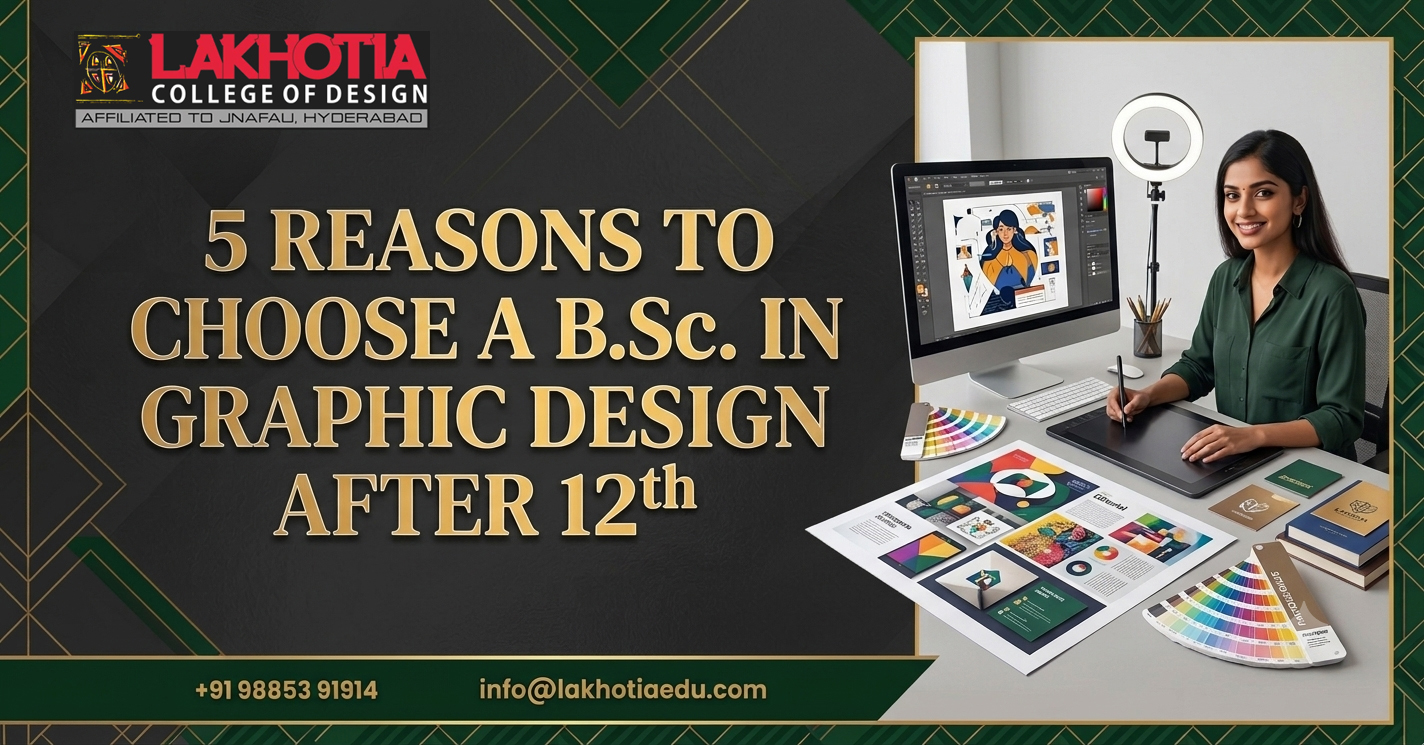
Every year, thousands of students complete their Class 12 examinations and face one of the most consequential decisions of their lives — choosing a career path. Engineering, medicine, and commerce remain popular choices, but a growing number of students are looking beyond conventional routes toward creative, future-ready professions. Graphic design is one of them.
Indias digital economy is expanding at an extraordinary pace. Businesses of every size — from local startups to multinational corporations — need skilled graphic designers to communicate their identity, products, and ideas visually. According to industry research, the demand for qualified graphic designers in India is expected to grow by over 20 percent through 2026, driven by the explosion of digital marketing, e-commerce, app development, and content creation.
A Bachelor of Science in Graphic Design is not a backup option for students who could not get into engineering. It is a deliberate, strategic choice made by students who understand that visual communication is the language of the modern economy. This article breaks down five clear reasons why a B.Sc. in Graphic Design after 12th is worth serious consideration — along with the career paths, eligibility criteria, and admission process you need to know.
Table of Contents
1. Why Choose a B.Sc. in Graphic Design?
2. Career Opportunities After a B.Sc. in Graphic Design
3. How to Choose the Best B.Sc. Graphic Design College
4. Eligibility for a B.Sc. Graphic Design Course
5. How to Apply for B.Sc. Graphic Design Admission 2026
6. FAQs About B.Sc. in Graphic Design
Why Choose a B.Sc. in Graphic Design?
Before exploring individual reasons, it helps to understand what a B.Sc. in Graphic Design actually involves. Unlike a short-term certificate or a diploma programme, a B.Sc. degree typically spans three years and provides students with both theoretical foundations and advanced practical skills. The curriculum covers visual communication, typography, branding, UI/UX design, motion graphics, digital marketing design, and packaging — preparing graduates for a wide range of professional roles.
Here are five substantive reasons why this degree deserves serious consideration after Class 12.
Reason 1: Graphic Design Is One of Indias Most In-Demand Digital Skills
The Indian digital advertising industry crossed Rs 35,000 crore in 2024 and continues to grow. Every brand running a social media campaign, every e-commerce company listing products online, and every startup launching a mobile app requires skilled visual communicators. The B.Sc. in Graphic Design equips students with precisely those skills — from brand identity design to interface design — that businesses actively recruit for.
Unlike many traditional professions where demand is concentrated in specific cities, graphic design opportunities exist across Hyderabad, Bengaluru, Mumbai, Delhi, and increasingly in tier-2 cities as digital adoption deepens.
Reason 2: The Degree Opens Multiple Career Tracks Simultaneously
A B.Sc. in Graphic Design is not a narrow qualification. Graduates enter the workforce with skills applicable across at least six distinct professional categories: brand design, digital marketing, UI/UX design, motion graphics, packaging design, and publishing. This versatility is particularly valuable in an economy where job roles evolve rapidly and professionals benefit from the ability to move across sectors.
Students who discover a specific passion during the course — say, UI/UX or motion graphics — can deepen their expertise in that area, while retaining the broad foundation that makes them employable across contexts.
Reason 3: Practical Skills Translate Directly to Freelance Income
One of the distinctive advantages of graphic design as a profession is the relative ease with which qualified practitioners can build a freelance practice alongside or instead of salaried employment. Students who graduate with a B.Sc. in Graphic Design carry a portfolio of real work — logo systems, brand identities, campaign materials, UI mockups — that they can present to clients from day one.
Indias freelance economy has grown significantly, with platforms connecting designers to clients locally and internationally. A well-trained graphic designer with a strong portfolio can earn between Rs 30,000 and Rs 80,000 per month as a freelancer within two to three years of graduation, depending on specialisation and client base.
Reason 4: The Course Develops Both Technical and Strategic Thinking
Graphic design education at the degree level is not merely about learning software. A well-structured B.Sc. programme teaches students to think like strategists — to understand brand positioning, consumer psychology, visual hierarchy, and communication objectives before picking up a design tool. This strategic dimension is what distinguishes a trained designer from someone who has simply learned to use Canva or Photoshop through online tutorials.
Employers consistently report that the gap between hired designers and rejected applicants is rarely technical ability alone — it is the capacity to understand a brief, propose a concept, and defend a design decision that separates candidates who get hired from those who do not.
Reason 5: Higher Education Pathways Remain Open
Students who complete a B.Sc. in Graphic Design are not constrained to the job market. The degree opens doors to postgraduate programmes in design, visual communication, UX research, advertising, and brand management — both in India and internationally. Several leading design institutions in Europe and the United Kingdom actively recruit Indian undergraduate students with strong portfolios and a recognised degree qualification.
For students whose ambitions extend beyond India, a B.Sc. in Graphic Design from a reputed institution is a legitimate pathway to international academic and career opportunities.
|
Skill Developed |
Where It Applies |
Industry Demand |
|
Visual Communication |
Branding, Advertising, Publishing |
High |
|
Typography |
All design disciplines |
High |
|
UI/UX Design |
App, Web, Software companies |
Very High |
|
Motion Graphics |
Digital media, OTT, Advertising |
High |
|
Brand Identity |
Startups, Agencies, Corporates |
High |
|
Packaging Design |
FMCG, Retail, E-commerce |
Medium-High |
Career Opportunities After a B.Sc. in Graphic Design
Graduates of a B.Sc. in Graphic Design programme are employable across a broad spectrum of industries. The following roles represent the primary career pathways available in 2026.
Brand and Visual Identity Designer
Brand designers create the visual systems — logos, colour palettes, typography guidelines, and brand standards — that define how companies present themselves to the world. This is one of the most respected and well-compensated areas of graphic design, with experienced brand designers earning Rs 6 to 15 lakhs per annum at established agencies and in-house teams.
UI/UX Designer
User interface and user experience design has become one of the highest-growth specialisations within the graphic design field. Companies building apps, websites, and software platforms require designers who can translate user needs into intuitive, visually coherent interfaces. Starting salaries for UI/UX designers in Hyderabad range from Rs 3.5 to 6 lakhs per annum, rising significantly with experience.
Social Media and Digital Content Designer
Every brand with a social media presence requires a consistent stream of well-designed visual content. Social media designers create posts, stories, reels covers, infographics, and campaign materials for Instagram, LinkedIn, YouTube, and other platforms. This role is available at agencies, in-house marketing teams, and as a freelance service.
Motion Graphics Designer
Motion graphics designers create animated visuals for advertisements, explainer videos, brand films, and social media content. With the growth of video content across platforms, demand for motion graphics skills has risen sharply. Professionals with both static and motion skills command premium compensation.
Packaging Designer
Packaging design is a specialised and commercially significant discipline, particularly relevant to FMCG, food and beverage, cosmetics, and retail sectors. Packaging designers work at the intersection of visual communication and three-dimensional form, creating packaging systems that attract consumers and communicate product values effectively.
|
Career Role |
Starting Salary (per annum) |
Growth Trajectory |
|
Brand Designer |
Rs 3.5 - 5 Lakhs |
Strong — agency and in-house |
|
UI/UX Designer |
Rs 3.5 - 6 Lakhs |
Very high — tech sector demand |
|
Social Media Designer |
Rs 2.5 - 4 Lakhs |
Stable — every brand needs this |
|
Motion Graphics Designer |
Rs 3 - 5 Lakhs |
Growing — video content expansion |
|
Packaging Designer |
Rs 3 - 5 Lakhs |
Consistent — FMCG sector |
|
Art Director (3-5 years exp) |
Rs 6 - 15 Lakhs |
Senior leadership track |
How to Choose the Best B.Sc. Graphic Design College
Choosing the right college for a B.Sc. in Graphic Design is a decision that will shape both the quality of your education and your professional trajectory. Here are the criteria that genuinely matter.
Faculty With Industry Experience
The most important factor in a design education is the quality of instruction. Look for institutions where faculty members have worked as practising designers — not solely as academics. An educator who has navigated real client briefs, agency environments, and industry deadlines brings a quality of insight that purely academic instruction cannot replicate.
Curriculum Updated to Industry Standards
Graphic design tools and practices evolve quickly. A curriculum that still centres on outdated software or ignores disciplines like UI/UX, motion graphics, and digital content is not adequately preparing students for the current job market. Ask prospective institutions specifically about how frequently their curriculum is reviewed and what tools are currently taught.
Portfolio Development Support
Employers hire designers based on their portfolio, not their marksheet. A college that builds portfolio development into the curriculum — through real-world projects, client briefs, competitions, and exhibition opportunities — is giving students a concrete competitive advantage at the point of graduation.
Placement Record and Industry Connections
A colleges placement record tells you whether its graduates are actually getting hired, and in what kinds of organisations. Ask for specific data: What percentage of graduates are placed within six months of graduation? What are the typical companies and salary ranges? How does the institution connect students with industry during the course?
Affiliation and Recognition
Check whether the institution is affiliated with a recognised university and holds relevant certifications. Affiliation affects the value of your degree for higher education applications, both in India and internationally. ISO certification and established industry partnerships are further indicators of institutional credibility.
Eligibility for a B.Sc. Graphic Design Course
The eligibility criteria for a B.Sc. in Graphic Design are generally accessible, making the programme suitable for students from a range of academic backgrounds.
|
Criterion |
Standard Requirement |
|
Minimum Qualification |
Class 12 (any stream — Arts, Commerce, or Science) |
|
Minimum Marks |
45-50% aggregate (varies by institution) |
|
Age |
17 years and above at time of admission |
|
Stream Requirement |
No specific stream requirement for most institutions |
|
Entrance Test |
Aptitude test or portfolio review (institution-specific) |
|
English Proficiency |
Basic English comprehension required |
It is worth noting that most graphic design colleges assess applicants not solely on academic marks but on evidence of creative aptitude — whether through a portfolio of existing work, a design aptitude test, or both. Students who have been drawing, designing, or creating content informally often perform well in these assessments regardless of their academic stream.
How to Apply for B.Sc. Graphic Design Admission 2026
The admission process for B.Sc. Graphic Design courses in 2026 follows a relatively straightforward sequence. Here is what to expect.
Step 1: Research and Shortlist Institutions
Begin by identifying institutions that offer recognised B.Sc. degrees in Graphic Design. Compare curriculum, faculty credentials, placement records, campus facilities, and fee structures. Make a shortlist of three to five institutions before applying.
Step 2: Check Application Deadlines
Application windows for 2026 admissions typically open between March and June. Some institutions offer early admission rounds with application deadlines as early as April. Missing an early round can limit your options, so track deadlines carefully.
Step 3: Prepare Required Documents
• Class 10 mark sheet and certificate
• Class 12 mark sheet and certificate
• Passport-size photographs
• Government-issued identity proof
• Portfolio of creative work (where required)
• Transfer certificate from previous institution
Step 4: Appear for Aptitude Test or Interview
Most design colleges conduct an aptitude assessment or a personal interview as part of the admission process. These assess creative thinking, visual sensitivity, and communication skills. Preparation typically involves practising drawing, reviewing design principles, and being able to speak about your creative interests.
Step 5: Accept Offer and Complete Enrolment
Once offered admission, complete the enrolment process within the specified deadline, including fee payment and document submission. Seats in reputed institutions fill quickly, particularly for the first application round.
FAQs About B.Sc. in Graphic Design
1. Is a B.Sc. in Graphic Design a good career choice after 12th?
A B.Sc. in Graphic Design is an excellent career choice for students with a genuine interest in visual communication and creative problem-solving. The degree opens pathways in branding, digital marketing, UI/UX design, motion graphics, packaging, and publishing. Indias growing digital economy means sustained demand for qualified graphic designers across sectors. Graduates with strong portfolios and practical skills are consistently hired by agencies, technology companies, media organisations, and e-commerce businesses. Starting salaries range from Rs 2.5 to 6 lakhs per annum depending on specialisation and institution, with significant growth potential as experience accumulates.
2. What is the duration and fee structure of a B.Sc. Graphic Design course?
A B.Sc. in Graphic Design is typically a three-year undergraduate programme. Fee structures vary significantly across institutions, ranging from approximately Rs 60,000 to Rs 2.5 lakhs per year depending on the college, location, and facilities offered. Some institutions offer fee concessions, merit scholarships, and instalment payment options. It is important to evaluate fee structures in the context of placement outcomes and the quality of education received, rather than selecting a programme solely on the basis of cost.
3. What subjects are taught in a B.Sc. Graphic Design programme?
A well-structured B.Sc. Graphic Design programme covers a comprehensive range of subjects across three years. Core subjects typically include visual communication principles, typography, colour theory, illustration, brand identity design, digital imaging, UI/UX design, motion graphics, advertising design, packaging design, and portfolio development. Most programmes also include modules on design history and theory, professional practice, and project management. The practical component — studio work, live projects, and industry briefs — usually constitutes the majority of assessment.
4. Can I pursue a B.Sc. in Graphic Design after a Science or Commerce background?
Yes. Unlike engineering or medicine, a B.Sc. in Graphic Design does not require a specific stream in Class 12. Students from Arts, Commerce, and Science backgrounds are all eligible, provided they meet the minimum aggregate marks requirement of the institution. The admission assessment focuses on creative aptitude and communication skills rather than subject-specific knowledge from Class 12. Students from non-Arts backgrounds who have developed creative skills independently often perform very well in design aptitude assessments.
5. What software skills will I learn in a B.Sc. Graphic Design course?
A contemporary B.Sc. Graphic Design curriculum typically includes training in the Adobe Creative Suite — Photoshop, Illustrator, InDesign, After Effects, and Premiere Pro. Additionally, UI/UX-focused components introduce students to Figma, Adobe XD, and related prototyping tools. Some programmes also cover 3D visualisation software relevant to packaging and spatial design. Beyond software, strong programmes emphasise the conceptual and strategic thinking that enables designers to use tools purposefully rather than mechanically.
6. What is the scope of a B.Sc. Graphic Design degree for higher education abroad?
A B.Sc. in Graphic Design from a recognised and affiliated institution is a valid qualification for postgraduate admission at design schools internationally. Students with strong portfolios and degree qualifications have gained admission to programmes in the United Kingdom, France, and other European countries. Some Indian design institutions have formal academic partnerships with international universities, which can facilitate credit transfer and direct entry into advanced programmes. Students aspiring to international postgraduate education should research specific institutional requirements early in their undergraduate study.
Why Choose Lakhotia College of Design
For students in Hyderabad considering a B.Sc. in Graphic Design, Lakhotia College of Design has earned a distinctive reputation over more than 30 years of design education. What sets the institution apart is not marketing language but a consistent track record: over 30,000 alumni working across India and internationally, ISO 9001:2015 certification, and affiliation with JNAFAU.
The Graphic Design curriculum at Lakhotia is built around a 75:25 practical learning model — meaning three-quarters of the student experience involves applied work rather than theory alone. Students benefit from industry workshops, celebrity designer mentorships, and exposure to real client briefs that build the kind of portfolio employers and international institutions respond to.
Lakhotias international academic partnerships and student mobility programmes provide opportunities that extend well beyond Hyderabad — including the possibility of beginning studies in India and completing higher education in Paris, as well as internship opportunities at fashion and design events in London, New York, Paris, and Dubai. For students with global ambitions, these pathways are a meaningful differentiator.
The colleges 100% placement assistance programme and active entrepreneurship support cell mean graduates receive structured support whether they are entering the job market or building their own creative practice.
Conclusion
A B.Sc. in Graphic Design after 12th is a genuine, professionally serious choice for students who understand the value of creative skill in a digital economy. The degree provides more than technical training — it develops the strategic thinking, portfolio depth, and professional networks that translate into sustained career success.
If you are a student finishing Class 12 and considering your options, or a parent supporting that decision, we encourage you to explore what a quality graphic design education looks like in person. Visit a campus, speak with current students and faculty, and review placement outcomes before deciding. The right choice is the one that aligns your specific interests and ambitions with an institution genuinely equipped to develop them.
Explore B.Sc. Graphic Design admissions for 2026 at Lakhotia College of Design, Hyderabad. Contact the admissions team at +91-98853 91914 or visit lakhotiaedu.com to schedule a campus visit.


.png)


Leave a reply